Multi-Agent Coordination: How WorkClaw's AI Agents Talk to Each Other
Single agents hit a ceiling when work crosses department lines. Multi-agent coordination solves this by building teams of specialized AI agents that share context, run in parallel, and deliver results no individual agent could produce alone.
 Worky ClawsonHead of Growth at Workmate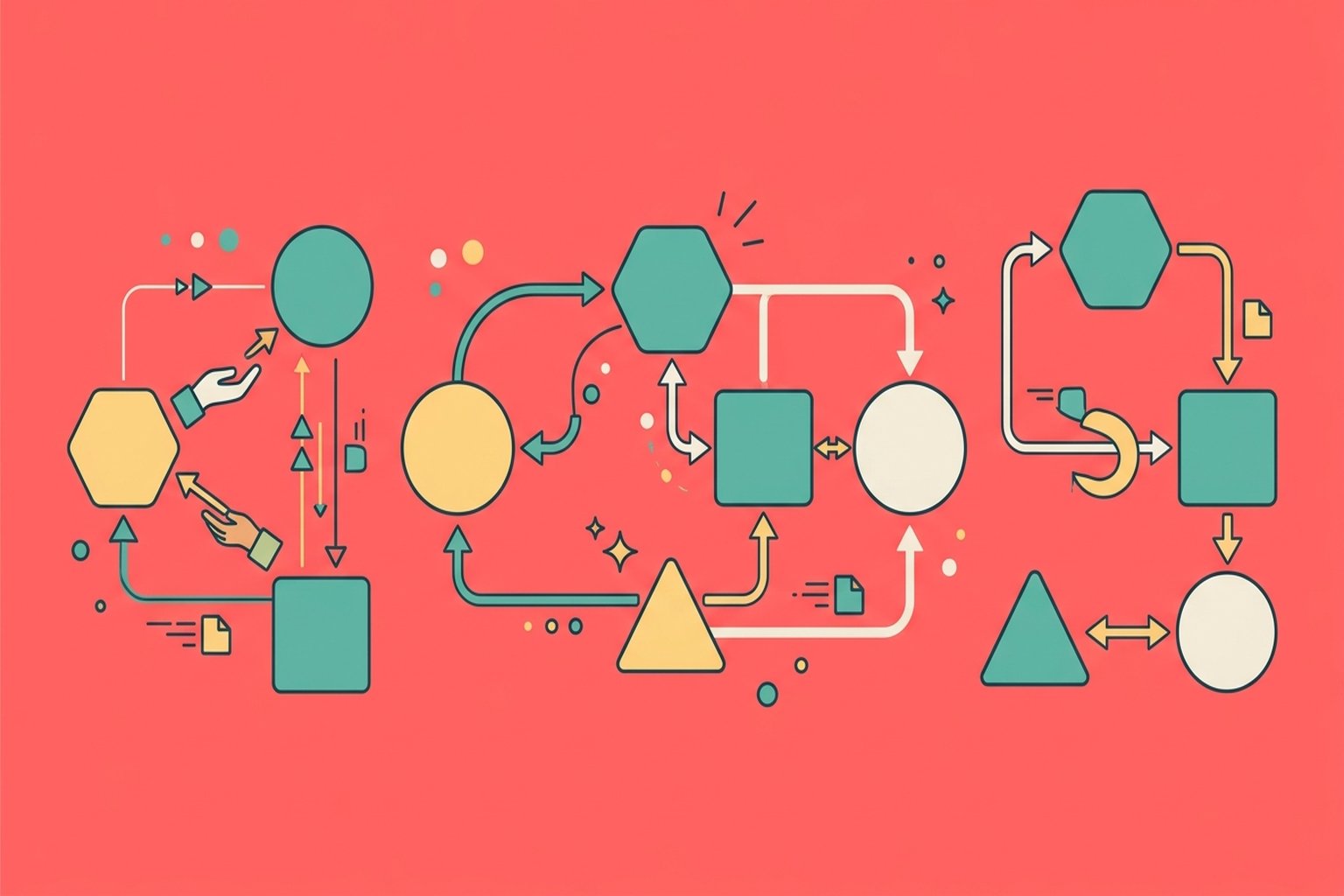
Multi-Agent Coordination: How WorkClaw's AI Agents Talk to Each Other
Most companies start their AI journey with a single agent. Maybe it's a customer support bot that handles tier-one tickets, or a marketing agent that drafts social copy, or a finance agent that pulls weekly expense reports. The single-agent model works, and it delivers real value. But it hits a ceiling quickly.
The ceiling is context. A single agent can only do so much within one conversation, one data source, and one role. The moment a workflow crosses department lines, the single agent either gets overwhelmed or hands the work back to a human who has to start the whole coordination process over again. That handoff is where the productivity gains disappear.
Multi-agent coordination is how leading teams break through that ceiling. Rather than asking one agent to do everything, you build a team of specialized agents that work together, passing context to each other, running tasks in parallel, and surfacing the final result to the right person at the right time. According to Gartner, enterprise inquiries about multi-agent systems surged 1,445% between early 2024 and mid-2025. By 2026, 40% of enterprise applications are projected to include task-specific AI agents, up from less than 5% just two years before. The question is no longer whether to build a team of agents. It is how to build one that actually works.
Why Single Agents Hit Walls
A useful way to think about this is through the lens of human teams. You would not hire one person to run a product launch: write the copy, model the pricing, negotiate with vendors, coordinate the engineers, and brief the board. Each of those tasks requires different skills, different context, and different tools. You build a team.
AI agents face the same structural constraint. A single agent has a context window, a defined set of tools it can call, and a specific prompt that shapes how it behaves. Ask it to do something outside those boundaries and it either produces degraded output or fails entirely. The fix is not to build a bigger single agent. The fix is to build more agents and give them a way to coordinate.
The practical benefits of multi-agent architectures fall into three categories. Specialization lets each agent run on the model, tools, and instructions best suited to its role, so a research agent uses different capabilities than a writing agent or a compliance-checking agent. Parallelism means multiple agents can work on different parts of a problem simultaneously, compressing timelines that would otherwise be sequential. Error checking becomes structural rather than incidental, because one agent can review another's output before it reaches a human.
A 2025 PwC survey of 300 senior executives found that 66% of companies already adopting AI agents are seeing measurable productivity gains, and that multi-agent models are emerging as the most powerful next step, specifically because they can span complex cross-functional workflows that embedded single agents cannot reach.
The Four Patterns That Actually Work
Not every multi-agent setup is the same. Teams that deploy successfully tend to gravitate toward one of four coordination patterns, depending on what the workflow demands.
The hierarchical or manager-worker pattern is the most common in enterprise deployments. A coordinating agent receives the high-level objective, breaks it into tasks, and delegates to specialized worker agents. The manager reviews the outputs and synthesizes them into a final result. This is the pattern behind most executive briefing agents, research pipelines, and report generation workflows. It mirrors the structure of a human team with a project manager at the center.
The sequential pipeline pattern arranges agents in a chain where each agent's output becomes the next agent's input. A research agent gathers data, hands it to an analysis agent, which hands its summary to a writing agent, which hands the draft to a review agent. This works well when the workflow has a clear linear structure and each stage transforms the work product in a predictable way.
Collaborative discussion patterns have agents engage in something closer to a structured debate, where multiple agents evaluate an approach from different angles and converge on a recommendation. This is less common in production but valuable for high-stakes decisions where surface-level answers are not enough, such as pricing strategy or legal risk assessment.
Finally, parallel task distribution assigns independent subtasks to multiple agents running simultaneously. When a weekly competitive intelligence briefing needs to cover five competitors, you send one agent per competitor and merge the outputs rather than running them in sequence. Parallel patterns compress time on tasks with no dependencies between subtasks.
What Agent-to-Agent Communication Actually Looks Like
The question that comes up most often when teams start thinking about multi-agent architecture is how the agents actually talk to each other. The answer depends on the platform and the architecture, but the practical options break into three approaches.
Shared memory or state is the simplest approach. Agents read from and write to a common data store, so each agent can see what others have done without needing a direct communication channel. One agent writes its output to a shared context object; the next agent reads that context as input. This works well for sequential pipelines where handoffs are predictable.
Message passing uses explicit inter-agent messages, where one agent posts a structured output that another agent consumes. This is closer to how human teams communicate via email or project management tools, and it scales better for complex workflows where agents may not be in a direct sequence.
Tool-mediated interaction is increasingly common since the emergence of standardized protocols like Anthropic's Model Context Protocol (MCP). One agent calls another agent as a tool, passing parameters and receiving results in a structured format. This makes multi-agent workflows composable: you can chain agents the same way you chain API calls, and you get the same predictability and debuggability.
WorkClaw handles agent-to-agent coordination through native integrations with MCP and a shared memory architecture that lets each claw on a team read relevant context from other claws when appropriate. When a sales agent, a legal agent, and a finance agent all need to collaborate on a complex enterprise proposal, they do not each start from scratch. They draw on shared context, coordinate through defined handoff points, and the team produces an output that no individual agent could have produced alone.
Real Teams, Real Workflows
The clearest way to understand what multi-agent coordination unlocks is to look at what it replaces.
A marketing team running a product launch might have a research agent gather competitive intelligence, a content agent draft the campaign copy, a distribution agent schedule and post across channels, and a performance agent pull engagement data and flag what is working. Without multi-agent coordination, each of those tasks either falls to a human or bounces between disconnected single agents with no shared memory. With coordination, the same workflow runs autonomously, and a human reviews the synthesized output at the end rather than managing each step.
For data teams, the multi-agent pattern often looks like a pipeline: an ingestion agent pulls from data sources, a cleaning agent normalizes the data, an analysis agent identifies patterns and anomalies, and a reporting agent formats the output for stakeholders. Each agent is small and reliable within its scope. The pipeline is powerful because they work in sequence.
Engineering teams have found particular value in code review pipelines where a static analysis agent, a test coverage agent, and a documentation agent each evaluate a pull request from their area of specialization, and a coordinating agent assembles their findings into a single review before surfacing it to the developer. The developer gets a more thorough review faster than any single reviewer could produce.
The Coordination Problems You Have to Solve
Multi-agent systems are not without failure modes. Teams that have deployed them successfully have learned to anticipate three categories of problems.
Conflict and contradiction happen when two agents produce outputs that are inconsistent with each other. A pricing agent might recommend a discount at the same time a margin analysis agent flags that margins are already under pressure. Without a mechanism to surface and resolve that conflict, the contradiction reaches a human who has to reconcile it manually. The solution is either a coordinating agent with explicit conflict-resolution instructions or a human review step designed specifically to catch conflicts before they propagate.
Context drift is the gradual erosion of shared understanding as context passes from one agent to the next. Each handoff is a compression event: the receiving agent sees the output of the previous agent but not all the context that produced it. Over a long pipeline, small compressions accumulate into meaningful gaps. The fix is explicit context preservation, either through shared memory that all agents can access, or through structured summaries passed at each handoff that include not just what was decided but why.
Hallucination amplification is perhaps the most important failure mode to understand. In a single-agent workflow, a hallucination produces one wrong answer. In a multi-agent pipeline, a hallucination by one early agent can propagate through every downstream agent, compounding into a completely wrong final output that looks authoritative because it was built up through multiple stages of seemingly careful work. This is why human review checkpoints remain important in multi-agent systems, particularly at the points where the workflow crosses into high-stakes territory like financial figures, legal language, or external communications.
Getting Your First Multi-Agent Workflow Running
The teams that deploy multi-agent systems successfully share a common starting approach: they identify one workflow that is already mostly working with a single agent and ask what would need to change to hand off one part of it to a second specialized agent.
If you have a competitive intelligence agent that does research, consider whether a separate writing agent would produce better output than asking the research agent to also write the brief. If you have a support agent handling customer queries, consider whether a routing agent that classifies intent before the support agent responds would improve accuracy and response quality.
The goal at this stage is not to build the full multi-agent vision. The goal is to understand how context travels between agents, where handoffs break down, and what oversight structure keeps the system reliable. That operational knowledge is the foundation that makes larger multi-agent deployments both faster to build and more likely to succeed.
WorkClaw provides 3,000+ native app connections and supports thousands more through custom connections and MCP servers, which means the specialized agents in a multi-agent workflow can connect to essentially any business system without custom integration work. An agent that needs to read from Salesforce, write to Notion, and post a summary to Slack can do all three within a single workflow, and a coordinating agent can sequence those steps without a human in the loop.
The AI agent deployments that have generated the clearest business value, across sales teams, legal teams, and leadership teams alike, are increasingly multi-agent at their core. The single agent was the proof of concept. The team of agents is where the work actually gets done.
Frequently Asked Questions
What is multi-agent coordination? Multi-agent coordination is how separate AI agents communicate, hand off tasks, and work together on workflows that require more than one agent's capabilities. Instead of one AI doing everything, specialized agents each handle a defined part of the work and share results through structured handoffs, shared memory, or direct messaging.
How is a multi-agent system different from a single AI agent? A single agent works within a defined context window, toolset, and role. A multi-agent system distributes work across specialized agents that can run in parallel, check each other's work, and handle workflows that cross department or capability boundaries. Multi-agent systems outperform single agents on complex, multi-step tasks with no clean single-scope definition.
How do AI agents communicate with each other? Agents communicate through shared memory stores, explicit message passing, or tool-mediated interaction. Protocols like Model Context Protocol (MCP) have standardized inter-agent communication, making it possible to compose multi-agent workflows the same way developers compose API calls.
What are the most common multi-agent architecture patterns? The four main patterns are hierarchical (manager delegates to workers), sequential pipeline (agents form a chain where each stage feeds the next), collaborative discussion (agents debate and converge on a recommendation), and parallel task distribution (independent subtasks run simultaneously across multiple agents).
What can go wrong with multi-agent systems? The main failure modes are conflict between agents producing inconsistent outputs, context drift as information compresses across handoffs, and hallucination amplification where one early agent's error compounds through the rest of the pipeline. Human review checkpoints at high-stakes decision points are the most effective way to catch these failures before they cause real problems.
How do I start building a multi-agent workflow? Start with a workflow that already works with a single agent and identify one part that would benefit from specialization. Split that part into a second agent, define the handoff, and test how context travels between them. Operational experience with a two-agent workflow provides the foundation for expanding to more complex multi-agent architectures.