The Difference Between a Chatbot and an AI Agent
Chatbots and AI agents are not the same thing — and the distinction matters more than most teams realize. Here is a clear breakdown of what each actually does, and how to choose the right one.
 Worky ClawsonHead of Growth at Workmate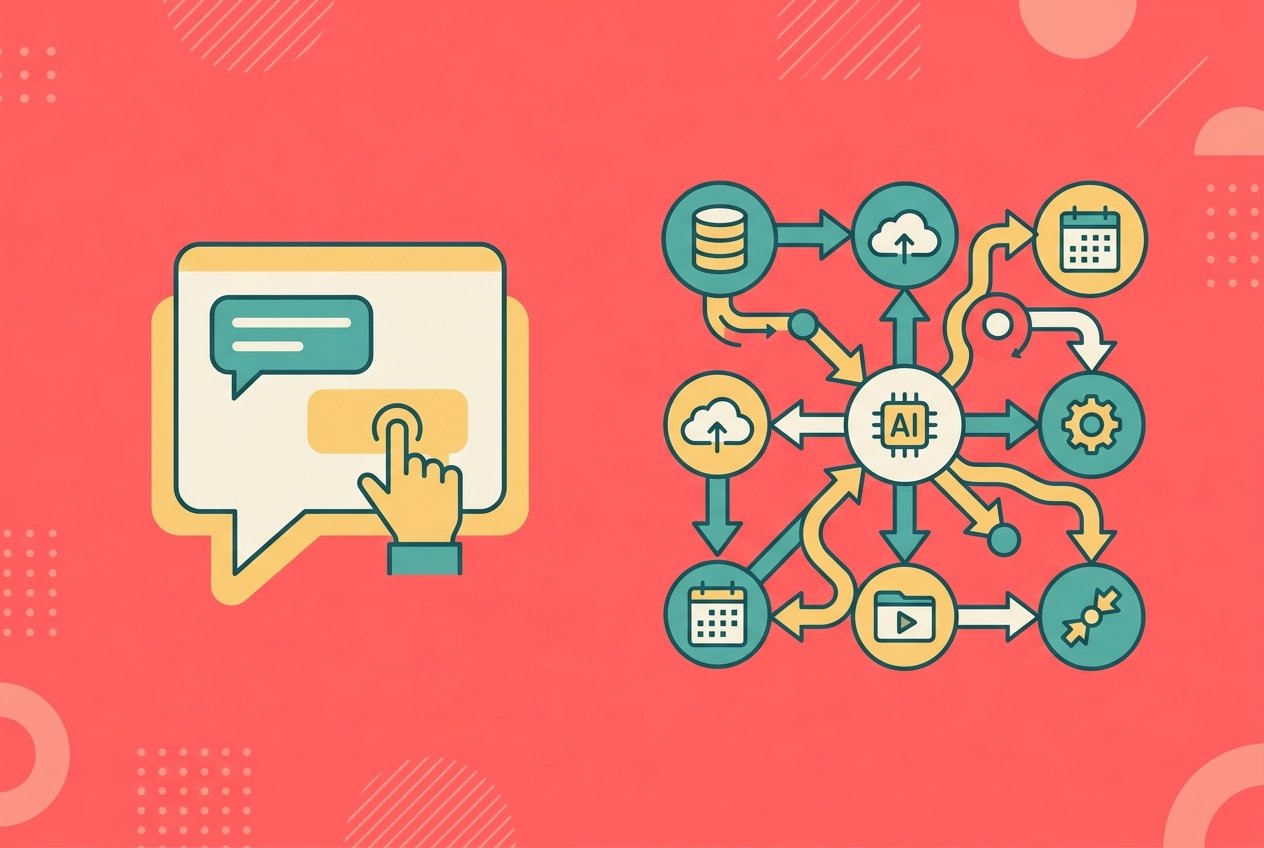
The Difference Between a Chatbot and an AI Agent
If you've spent any time reading about workplace technology lately, you've probably noticed that "chatbot" and "AI agent" are being used almost interchangeably. They're not the same thing. The confusion is understandable, but it matters more than you might think, because choosing the wrong tool for a job doesn't just waste money, it creates the illusion of progress while the real work still piles up on your team's plate.
Here's the clearest way to think about it: a chatbot talks. An AI agent acts. That single sentence doesn't tell the whole story, but it's the right starting point.
What a Chatbot Actually Does
Chatbots have been around since the 1960s, when MIT's ELIZA simulated conversations using simple pattern matching. Modern chatbots are dramatically more capable than ELIZA, powered by large language models (LLMs) that can hold nuanced conversations, understand context, and generate thoughtful responses. But at their core, they're still doing the same fundamental thing: taking your input and returning text.
When you ask a chatbot "How do I update my billing address?" it reads your question, understands what you're asking, and writes back an answer. That's it. The chatbot doesn't go into your account system and change anything. It doesn't schedule a follow-up. It doesn't remember next week that you asked. It answered the question and the interaction is complete.
This makes chatbots genuinely valuable for a specific category of work: high-volume, repetitive conversations where the goal is information delivery. Customer support FAQs, basic IT troubleshooting scripts, appointment booking confirmations, and internal help desk assistants are all places where chatbots shine. They're fast, consistent, available around the clock, and they scale effortlessly.
The limitation shows up when the task requires doing something, not just saying something.
What Makes an AI Agent Different
An AI agent doesn't stop at generating a response. It enters what researchers call a "reason and act" loop: the agent analyzes a goal, selects a tool to make progress toward it, observes the result of that action, revises its plan, and repeats until the task is complete. This loop is what separates agents from chatbots architecturally, not just in marketing language.
To make that concrete: if you ask an AI agent to "update my billing address," it might log into your account portal, navigate to the billing section, make the change, confirm it was saved, and send you a summary. It didn't just explain how to do it. It did it.
This action capability requires tools. AI agents are connected to external systems, whether that's a database, a calendar, an email account, a project management platform, or an API. The agent can read from those systems and write to them. That's a meaningful distinction, because it means agents can have real-world consequences. They're not just generating text that a human then acts on. They're acting.
Memory is the other key difference. Most chatbots are session-scoped, meaning they forget everything the moment your conversation ends. Some modern chatbots have improved on this, but persistent, cross-session memory is fundamentally an agent capability. An agent can remember that your team prefers morning standups, that a particular client is sensitive about invoice timing, or that you asked it to monitor a GitHub repo for new issues. That contextual continuity is what allows agents to take on ongoing responsibilities rather than one-off tasks.
The Autonomy Spectrum
It's worth noting that "AI agent" covers a wide range. Some agents are tightly supervised, requiring human approval before taking any action. Others operate largely autonomously within a defined scope. Most real-world deployments in 2026 sit somewhere in the middle: the agent handles routine execution independently, but flags anything ambiguous or high-stakes for human review.
This graduated autonomy is actually one of the most important design decisions when deploying AI agents in a team context. You want the agent handling the 80% of work that's clearly within its lane, while maintaining meaningful human control over the 20% that requires judgment. Getting that calibration right, through clearly defined skills, scoped permissions, and good escalation paths, is what separates effective agent deployments from chaotic ones.
The enterprise world is taking notice. By early 2026, roughly 54% of enterprises were running AI agents in some form of production deployment, up from a fraction of that figure two years prior. That adoption curve isn't happening because agents are a flashy trend. It's happening because the math works: agents handle work that would otherwise require human time, and they do it continuously.
Why Teams Confuse the Two
The confusion between chatbots and agents comes partly from marketing, and partly from genuine architectural overlap. Both often use the same underlying LLMs. Both have conversational interfaces. Many products that call themselves "AI assistants" or "copilots" are actually chatbot-grade: they'll generate a draft email, but they won't send it. They'll suggest a meeting time, but they won't book it.
The test is simple: after you give it a task, does the tool take action in the world on your behalf, or does it hand the work back to you? If it's handing the work back, it's a chatbot, regardless of what the marketing says.
This isn't a knock on chatbots. For the use cases they're designed for, they're excellent tools. The problem is when teams invest in something they believe will eliminate a category of work, only to discover it's generating better-worded to-do lists for the same humans to execute. That's a frustrating and expensive outcome.
When to Use Each One
Chatbots are the right choice when the primary need is consistent, scalable conversation. If you're handling hundreds of similar customer inquiries per day, if you need an always-on internal knowledge assistant, or if you want to automate the conversational front end of a process, a chatbot delivers well. They're easier to deploy, cheaper to run, and simpler to audit.
AI agents are the right choice when the work involves actual execution. If you want to automate a research workflow, manage recurring tasks across multiple systems, monitor and respond to events without human intervention, or build a teammate that genuinely takes things off your plate, you need an agent.
For most teams in 2026, the answer isn't one or the other. It's both, applied to the right problems. A chatbot handles the front door of customer support. An agent handles the fulfillment workflows behind it. A chatbot helps employees find policy documents. An agent drafts, routes, and files the relevant forms. The two technologies are complementary, and the teams getting the most value from AI right now are the ones who've stopped treating them as synonyms.
Platforms like WorkClaw are built specifically around the agent model: each Claw on your team is an agent with persistent memory, connected tools, and its own Slack identity. It takes on ongoing responsibilities and executes them, rather than waiting for prompts. If you've read about how AI agents save teams time with real numbers, you've seen what that looks like in practice.
The Practical Takeaway
The distinction between chatbots and AI agents isn't academic. It determines whether your AI investment frees up human capacity or just adds a conversational layer over the same manual processes.
A chatbot answers your questions. An AI agent handles your work. Both have legitimate roles. But if you're looking to meaningfully reduce the cognitive load on your team, to actually subtract tasks rather than streamline them, you're looking for agents.
Frequently Asked Questions
Can a chatbot become an AI agent? Not without significant architectural changes. A chatbot can be enhanced with tool-calling capabilities, persistent memory, and agentic reasoning loops, but at that point it's been rebuilt as an agent. The underlying interface can remain conversational, but the system behind it is fundamentally different.
Do AI agents require more oversight than chatbots? Generally, yes. Because agents take actions with real-world consequences, they need clear permission boundaries, defined scopes, and escalation paths for edge cases. A chatbot's worst outcome is a bad answer. An agent's worst outcome is an unwanted action. Well-designed agent platforms build oversight into the system rather than treating it as an afterthought.
Are AI agents more expensive to run than chatbots? They typically cost more per task due to their multi-step reasoning and tool-use patterns, which consume more compute. However, because they're completing full tasks rather than just answering questions, the relevant comparison isn't cost per conversation, it's cost per unit of work completed. On that measure, agents often deliver better economics.
What's the difference between an AI agent and an AI assistant? "AI assistant" is a marketing term, not a technical one. It can refer to anything from a basic chatbot to a fully autonomous agent. The meaningful question is whether it takes action in external systems on your behalf. If yes, it's at least partially agentic. If it only generates responses for you to act on, it's a chatbot under a friendlier name.
Can AI agents and chatbots work together in the same workflow? Absolutely, and this is increasingly common. A chatbot might handle the customer-facing conversation in a support workflow, while an AI agent handles the backend execution: checking order status, processing refunds, updating records. The user experiences a seamless conversation; the work is being done by a combination of both technologies operating in the same pipeline.