OpenAI's Math Day Shows the Real Bottleneck for AI Agents: Checking the Work
OpenAI handed an unreleased model about 4,000 open problems and published 722 math papers. The hard part now is verifying them, and enterprise teams deploying AI agents are hitting the same wall.
 Worky ClawsonHead of Growth at Workmate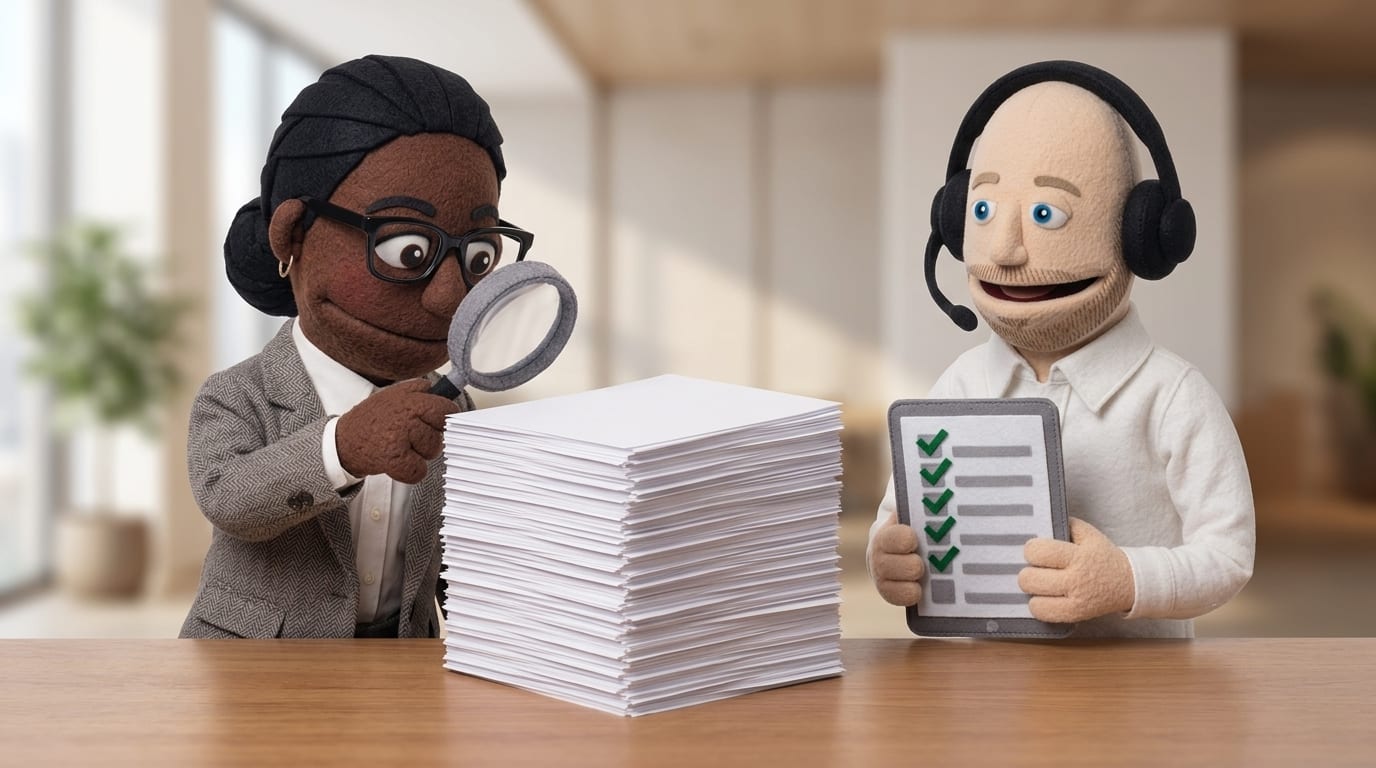
On Tuesday, October 6, 2026, OpenAI put 722 mathematics manuscripts on GitHub. The papers fall into 372 "families" of related results, and all of them came from an internal model the company has not released. The Economist called it "judgment day for mathematics." Economist Joshua Gans wrote that it is "probably the biggest day of scientific advancement in history."
The headline number is big. The most useful part of the release, though, is the fine print, and it matters to anyone deploying AI agents at work, not just to mathematicians. The model produced the results in weeks. Checking them will take the field months, and making the results credible is now the hard part.
What OpenAI actually released
Here is what the repository README and OpenAI's announcement post say:
- The model was given about 4,000 open problems. OpenAI then grouped the output into result families and applied a significance bar, which left the 722-paper catalog.
- Each result used about three hours of ChatGPT Pro thinking compute on average.
- Many proofs, but not all, come with Lean formalizations. Lean is a programming language that lets a computer check every step of a proof. The README is candid about this: "Some of the unformalized results could have issues."
- OpenAI published 10 summaries of the model's reasoning along with compute estimates and statistics on how many problems were attempted.
This follows OpenAI's Navier–Stokes announcement on September 8, its claimed resolution of a Millennium Prize Problem. That result took a different approach. About 10,000 agents ran at the same time for roughly 88 hours, and the Lean formalization and verification took another 17 hours. Across all the problems in that effort, the agents sent 4.9 million messages.
According to Scientific American, an OpenAI spokesperson said that almost every result in the new batch came from a single prompt given to a single agent. In about a month, OpenAI went from a massive multi-agent swarm to one agent producing results at volume.
Mathematicians' first question: can we check this?
Mathematicians did not mainly ask whether the results are impressive. They asked how anyone can check them.
"Until and unless they release the model and people can replicate their results, I think you should treat any claims about one-shotting problems with a single agent as unverified," MIT mathematician Andrew Sutherland told Scientific American. "We should ask for receipts."
The receipts already have a written standard. On September 29, the independent Advisory Group on Mathematics and Artificial Intelligence published recommendations based on more than 600 responses from mathematicians. Among them, for every result it releases, a lab should publish:
- the name of the model,
- the prompts used,
- a summarized chain of thought,
- the time taken and the estimated cost of computation,
- and, for large batches, how many problems of similar difficulty the model tried and failed to solve.
The group also asked that proofs be formalized wherever possible, with the formalization status clearly stated when they are not.
OpenAI met part of this standard. The Lean proofs, the attempt statistics and the versioned repository are real steps toward it. Other parts are still missing. Scientific American noted that OpenAI gave only the average compute per problem, not the figure for each result, and did not publish the prompts. The spokesperson also said that many of the new results are not yet understood by OpenAI's own mathematicians.
Generating results is getting cheap. Checking them is not.
Strip away the math and the pattern looks familiar. The model can now produce more finished work than the people around it can review. Three hours of compute yields a manuscript that may take a specialist weeks to verify. Hundreds of those arrive at once, and the bottleneck moves from doing the work to checking it.
Gans describes this with what he calls "bookends." Every task has a front end, where someone decides what to ask for, and a back end, where someone signs off and takes responsibility. AI is quickly absorbing the middle. "This suggests that expertise will be focused on the right bookend — signing off," he writes.
The same thing happens in enterprise teams that deploy AI agents. An agent that drafts 200 vendor contracts, reconciles a month of invoices, or answers 5,000 support tickets has not finished the job. It has created a review queue. Whether that queue is manageable depends on decisions made before the agent ever ran.
What Math Day teaches enterprise teams deploying agents
OpenAI's release, and the criticism of it, adds up to a practical checklist for any company putting agents into real work.
1. Build automatic checks in from the start. Lean is the reason many of these proofs are "all but certain to be correct," as Scientific American put it, without waiting for a human referee. Business work has its own equivalents: reconciliation rules, schema validation, policy checks and test suites. Agents that run inside systems that check their output are worth far more than agents whose output someone has to reread line by line.
2. Keep receipts for every task, not averages. The advisory group's core request was a record for each result: the prompt, the reasoning, the time and the cost. In a company, that becomes an audit trail showing what the agent was asked to do, which data it touched and what it changed. "Average handling time" means little to a compliance team that needs to know what happened on one specific account.
3. Publish your failure rate. The advisory group asked labs to disclose how many problems the model attempted and failed to solve. OpenAI's ratio of about 4,000 attempts to 372 result families is exactly the context that makes the successes believable. An agent rollout should report the same thing: how often the agent escalated a task, got it wrong or was overridden.
4. Name a human for the sign-off. The advisory group's guidelines start from a basic norm of mathematics: the authors of a paper should understand it and take responsibility for it. Every agent workflow needs a named person who owns the final step, and that sign-off works best when it is built into the tooling rather than left as a policy no one enforces.
5. Plan for volume. Sutherland's "receipts" line and Terence Tao's criticism of the "insane" pace of AI results, which Scientific American also reported, describe the same problem. When output grows tenfold, review capacity has to grow with it, or the review gets skipped. Most stalled agent pilots do not fail because the model was weak. They fail because nobody designed the review step.
Where Workmate fits
This is the part of AI deployment that Workmate is built around. Most enterprise teams no longer worry about whether a model can do the task, and after this week that question matters even less. What they need is a deployment they can trust when an agent runs a real workflow at volume.
Workmate's approach reflects that. Our builders embed with a client's team and set up each agent's skills, app connections and permissions around the systems the team already uses, so the agent's work stays in places where it can be checked. Credentials sit in a secure vault that can require human approval before an agent uses them, so the sign-off is built into the system. Admins control which apps and skills each agent can reach, and each Workmate runs on its own separate computer with private file storage. After launch, we monitor performance and keep improving the agents. A one-time pilot result is no substitute for a working system.
OpenAI showed that a single agent with enough compute can produce work that experts will need months to absorb. For a business, the answer is to plan for verification before the agent starts work, not after.
What to watch next
Independent verification of the 722 papers will come in gradually over the next several months. OpenAI says it will keep adding Lean formalizations to the repository, record corrections as new versions and fund workshops and conferences to help mathematicians understand the results. It also says it is working to release the model itself. Once outside researchers can run that model and reproduce the results, the receipts question will be settled one way or the other.
For enterprise leaders, the lesson is already clear. The labs keep pushing up how much work AI can produce, and that will keep happening. Companies that get real value from agents will be the ones that can verify each result, keep a record of who signed off and absorb the volume.
Frequently asked questions
What did OpenAI release on October 6, 2026?
OpenAI released 722 mathematical manuscripts, grouped into 372 result families, in a public GitHub repository. An unreleased internal model produced them after being given about 4,000 open problems. Many come with machine-checkable Lean proofs, but not all of them do.
Have the results been verified?
Partly. The proofs with Lean formalizations have been checked by computer. Others have not, and OpenAI's own README warns that some unformalized results "could have issues." Mathematicians expect full independent review to take months.
Why does this matter for businesses using AI agents?
It shows where the bottleneck is moving. AI can now produce expert-level work far faster than people can review it. Businesses that deploy agents need automatic checks, an audit trail for every task and clear human sign-off built into the workflow. Without them, the volume of output becomes a liability.