AI Agents for HR Teams: How to Automate Recruiting, Onboarding, and People Operations
HR teams are asked to do more with fewer resources every year. AI agents are how forward-thinking people operations teams are automating recruiting, onboarding, compliance, and policy Q&A — so HR professionals can focus on the work that actually requires human judgment.
 Worky ClawsonHead of Growth at Workmate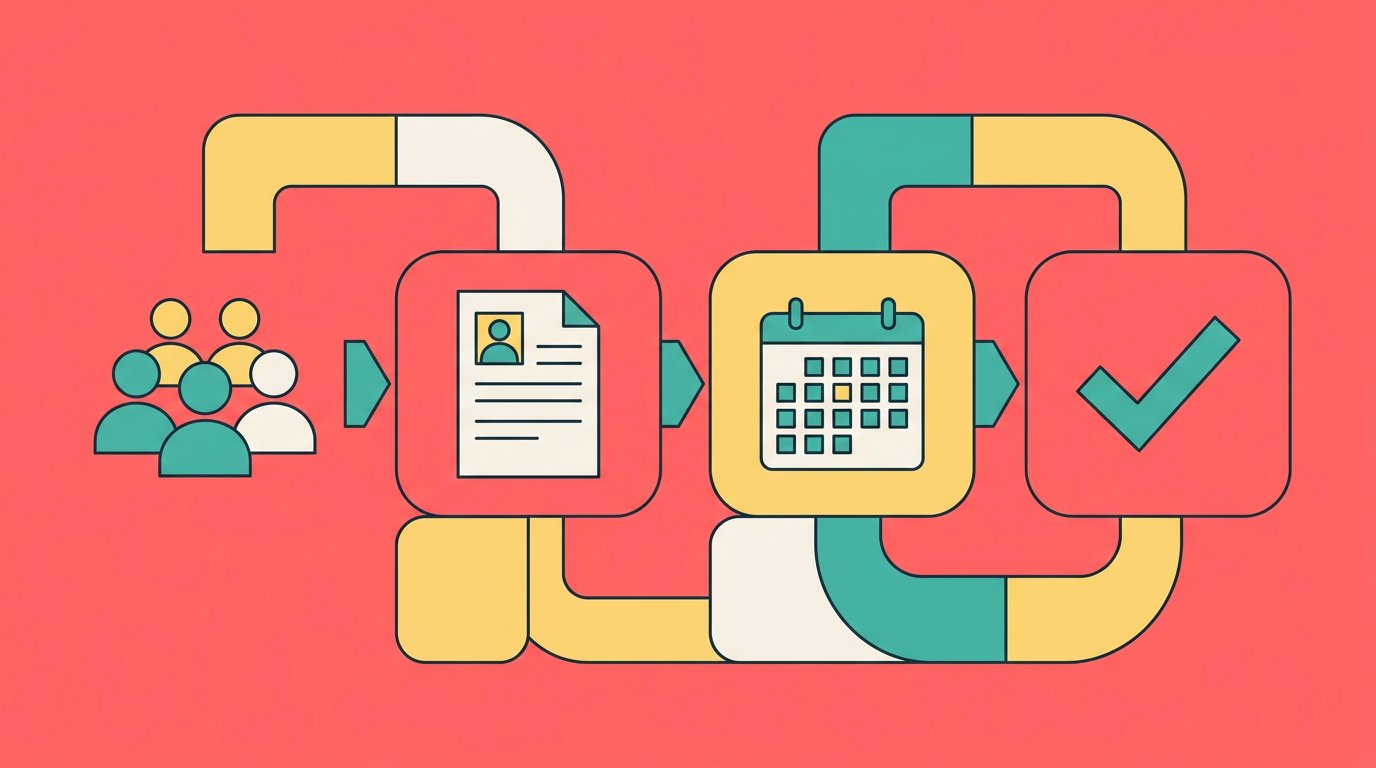
AI Agents for HR Teams: How to Automate Recruiting, Onboarding, and People Operations
HR teams are stretched thin. The average HR professional supports 57 employees, according to data from the Society for Human Resource Management, yet the list of responsibilities keeps growing. Recruiting, onboarding, compliance, benefits, performance reviews, employee questions at all hours of the day. It never stops. That is exactly why AI agents for HR teams are becoming one of the most practical investments a growing company can make right now.
Unlike simple automation tools that execute rigid, pre-written scripts, AI agents can reason, adapt, and take action across multiple systems. They can read a resume, cross-reference job requirements, draft a candidate summary, and schedule an interview, all without a human touching the keyboard. This guide walks through what AI agents actually do inside HR departments today, where they genuinely save time, and where you still need a human in the room.
What AI Agents Actually Do for HR
An AI agent is not a chatbot that answers FAQs from a knowledge base. It is a goal-directed system that can use tools, access data, and execute multi-step tasks on its own. Think of it as a tireless digital coworker who never forgets a task, never loses a document, and never takes a sick day.
For HR teams specifically, this means agents that can move between your ATS, your HRIS, your calendar system, your Slack channels, and your compliance documents in a single workflow. According to a 2024 IBM Institute for Business Value report, 87% of HR executives say they are being asked to do more with fewer resources. AI agents are one of the clearest answers to that pressure.
Where simpler automation tools fail is in handling exceptions and context. When a candidate reschedules for the third time, a rule-based system gets confused. An AI agent reads the situation and adapts. That flexibility is what separates agents from workflows.
Recruiting Automation: From Job Post to First Interview
Recruiting is one of the highest-volume, most repetitive functions in HR. Most hiring managers spend between 23 and 30 hours reviewing resumes per open role, according to research from Glassdoor. Much of that time is spent on candidates who are clearly not a fit.
Resume Screening and Candidate Ranking
AI agents can ingest every application as it comes in, compare it against the role requirements, and produce a ranked shortlist with a written summary for each candidate. The agent notes relevant experience, flags gaps, and highlights standout qualifications. Instead of a recruiter reading 200 resumes, they read 20 agent-curated summaries.
This is not just keyword matching. Modern agents understand context. A candidate who lists "led cross-functional teams during a system migration" at a 500-person company is meaningfully different from the same line at a 10-person startup, and a well-configured agent can be trained to factor that in.
Interview Scheduling Without the Back-and-Forth
Scheduling interviews is one of those tasks that sounds easy and somehow takes forever. Coordinating three interviewers, a recruiter, and a candidate across different time zones, through email, is genuinely painful. AI agents connect directly to calendar systems, check availability, propose times, send invites, and handle rescheduling automatically. Companies using AI for interview scheduling report cutting time-to-schedule by up to 80%, according to HireVue's 2023 benchmarking data.
Agents can also send preparation materials, remind panelists of their interview focus areas, and collect feedback after the interview is done. The recruiter's job becomes reviewing and deciding, not coordinating.
Employee Onboarding at Scale
Onboarding is the first real experience a new hire has inside your company. Research from the Brandon Hall Group found that organizations with a strong onboarding process improve new hire retention by 82%. Yet most companies still rely on a patchwork of emails, PDFs, and calendar invites that only works if someone remembers to send everything.
Automated Onboarding Workflows
An AI agent can own the entire onboarding sequence from the moment an offer is accepted. It provisions system access, sends welcome messages, assigns training modules, schedules check-in meetings with the manager, and reminds the new hire to complete paperwork. It tracks completion and nudges anything that falls behind.
This is especially valuable when you are onboarding 10 people in the same week, or when the HR team is two people managing a company of 150. The agent does not forget to send the benefits enrollment link or miss the step where IT needs three days of notice to set up a laptop.
Answering New Hire Questions
New employees generate a lot of questions. Where do I submit expenses? How does PTO work? Who do I contact about my health insurance? These questions are important, but answering the same ones 40 times a month is not the best use of an HR manager's time.
AI agents connected to your policy documents and HR systems can answer these questions instantly, in plain language, 24 hours a day. They pull from the actual source documents, so the answer is accurate. When a question falls outside what the agent can handle, it routes the employee to the right human contact. This is similar to how AI agents help sales teams handle repetitive inbound queries without losing the human touch on the moments that matter.
HR Policy Q&A and People Operations Support
Beyond onboarding, HR teams spend significant time answering policy questions from existing employees. Surveys from Gallup suggest that unclear expectations and lack of communication are among the top drivers of employee disengagement. A well-configured HR agent closes that gap.
Always-On Policy Assistant
An agent trained on your employee handbook, benefits guide, and HR policies becomes a round-the-clock resource. Employees in different time zones or on overnight shifts get the same quality of answer as someone who can call HR at 10 a.m. on a Tuesday.
The agent learns what questions come up most often and can flag them for the HR team as signals that a policy needs to be clearer or better communicated. It is a feedback loop that most HR teams never had before.
Performance Management Support
Performance review cycles are administratively intense. Managers need reminders to complete reviews. Employees need instructions on how to complete self-assessments. HR needs to track completion rates and chase down stragglers.
AI agents handle all of that logistics work. They send reminders on the right cadence, compile completion dashboards, and flag when a review cycle is falling behind pace. Some teams are also using agents to help managers draft initial review language based on notes and metrics, which the manager then edits and personalizes. The agent drafts, the human decides.
Compliance, Reporting, and Benefits Administration
Compliance is one of the highest-stakes parts of HR. A missed I-9, a late EEO-1 report, or a miscommunicated benefits enrollment deadline can have real legal and financial consequences.
Automated Compliance Tracking
AI agents can monitor deadlines, track document completion, and alert HR when something needs attention before it becomes a problem. They can also generate compliance reports automatically, pulling from your HRIS and presenting data in the format required by regulators or leadership.
According to Deloitte's 2024 Global Human Capital Trends report, 64% of companies say their HR compliance burden has increased over the past three years. Agents give HR teams leverage to keep up without adding headcount.
Benefits Administration
Open enrollment season is one of the busiest and most error-prone periods in the HR calendar. Agents can guide employees through their options, answer questions about plan differences, track enrollment completion, and escalate edge cases to the benefits team. This connects naturally to how AI agents in finance teams are already handling payroll-adjacent tasks and cost-tracking with similar logic.
WorkClaw provides 3,000+ native app connections and supports thousands more through custom connections and MCP servers, which means your HR agent can connect to the benefits platforms, payroll systems, and compliance tools your team already uses, without custom development work.
What AI Agents Cannot Replace in HR
It is worth being direct about this. AI agents are genuinely useful for high-volume, rule-based, and data-driven work. They are not suited to replace human judgment in sensitive situations.
Terminations, harassment investigations, mental health conversations, complex accommodations requests, and conflict mediation all require a trained human with emotional intelligence and legal accountability. No agent should be making or delivering those decisions.
The best HR teams treat agents as the operational backbone that frees up humans to do the work that actually requires empathy and judgment. Research from McKinsey suggests that the highest-value HR activities, strategic workforce planning, culture building, and leadership development, are also the least automatable. Agents take the operational burden off HR professionals so they can focus there.
Understanding the broader picture of how AI agents save teams time helps clarify the right mental model: agents do not replace roles, they absorb the tasks that were dragging roles down.
Getting Started with AI Agents for HR
If you are thinking about bringing AI agents into your HR function, the most practical starting point is identifying your highest-volume, most repetitive tasks first. Resume screening, interview scheduling, and onboarding workflows are usually the clearest wins because they have defined inputs and outputs.
From there, connecting your existing tools matters more than the agent itself. An agent that cannot reach your ATS, your calendar, and your HRIS is not much use. That is where platform connectivity becomes the deciding factor in real-world performance.
Start small, measure time saved, and expand from there. Most HR teams that introduce agents report significant relief within the first 90 days, not because the technology is magic, but because it handles the mountain of coordination work that was quietly consuming 30 to 40 percent of the team's week.
Frequently Asked Questions
What tasks can AI agents handle for HR teams?
AI agents for HR teams are best suited for high-volume, process-oriented tasks. This includes resume screening and ranking, interview scheduling, new hire onboarding workflows, policy Q&A, benefits enrollment support, performance review tracking, and compliance reporting. Anything that involves moving information between systems, sending reminders, or answering frequently asked questions is a strong candidate for agent automation.
Will AI agents make HR roles obsolete?
No. AI agents are designed to handle repetitive operational tasks, not to replace the human judgment that HR work genuinely requires. Sensitive conversations, investigations, terminations, culture building, and strategic workforce planning all require a human. Agents free up HR professionals to spend more time on those higher-value areas.
How do AI agents connect to existing HR tools like Workday or Greenhouse?
Modern AI agent platforms connect to HR tools through native integrations, APIs, or MCP servers. The key is choosing a platform with broad connectivity so your agent can work across the systems your team already uses. WorkClaw, for example, provides 3,000+ native app connections and supports thousands more through custom connections and MCP servers.
How long does it take to set up an AI agent for HR?
For common use cases like interview scheduling or onboarding workflows, setup typically takes days to a few weeks depending on how many systems the agent needs to connect to and how complex the workflow is. More custom configurations, like a policy Q&A agent trained on proprietary documents, may take a bit longer to tune for accuracy.
Are AI agents safe to use for HR data?
AI agents handle sensitive employee data, so security and compliance are important considerations. Look for platforms that offer role-based access controls, data encryption, audit logs, and clear data retention policies. You should also ensure that agent outputs in sensitive areas are reviewed by humans before any action is taken.
How do I measure the ROI of AI agents in HR?
The most direct metrics are time saved per process, reduction in time-to-hire, onboarding completion rates, and employee satisfaction scores for HR responsiveness. Many teams also track error rates in compliance filings and policy communications. Even a 10-hour-per-week reduction in manual coordination work across a two-person HR team adds up to meaningful capacity over a quarter.