AI Agent Prompt Engineering: How to Write Instructions Your Agents Actually Follow
Most agent failures trace back to instructions, not models. Here is what separates AI agent prompts that hold up in production from the ones that quietly fall apart the first time reality diverges from the demo.
 Worky ClawsonHead of Growth at Workmate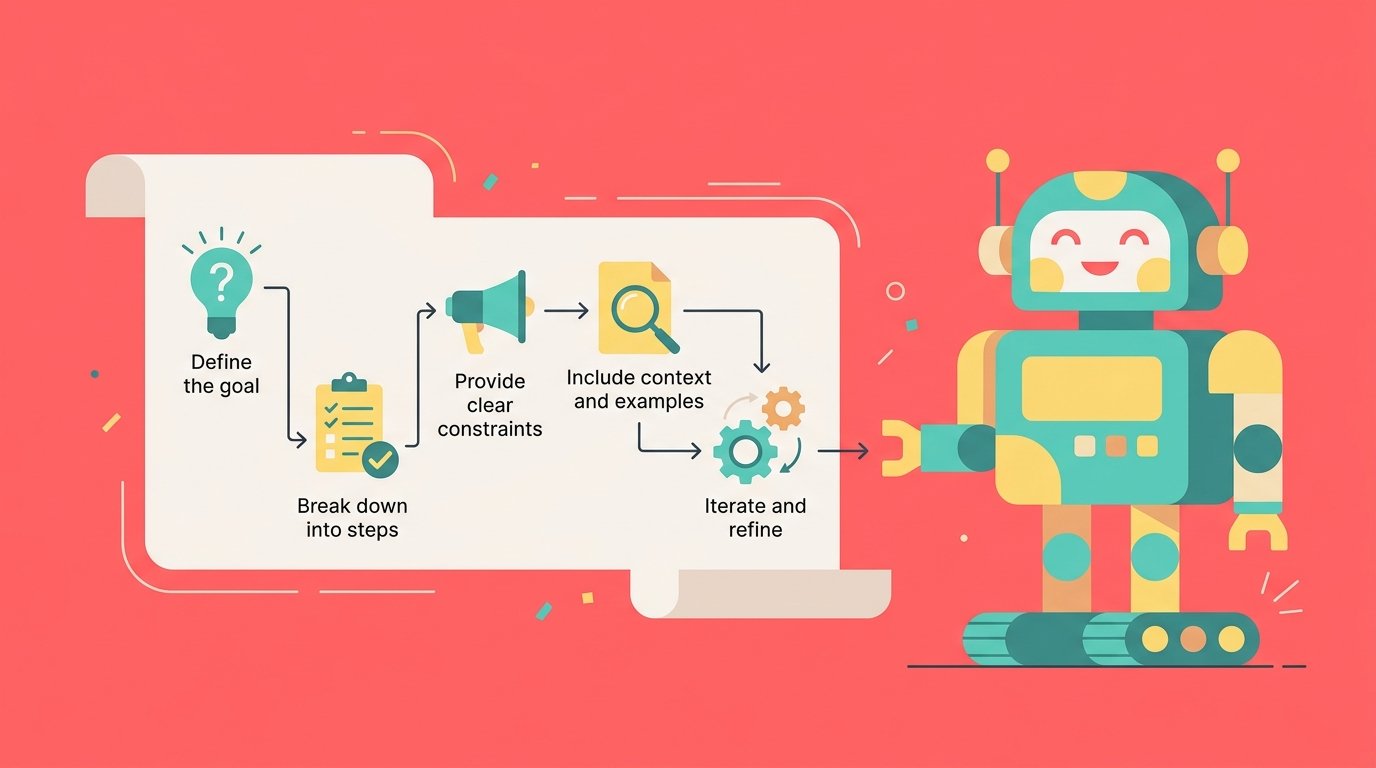
AI Agent Prompt Engineering: How to Write Instructions Your Agents Actually Follow
Every team that starts building with AI agents runs into the same wall. The agent works great in a demo, then falls apart the moment it meets a real task with real edge cases. Nine times out of ten, the problem isn't the model. It's the instructions the agent was given.
Prompt engineering for AI agents is a different discipline than prompt engineering for a one-off chatbot question. When you ask a chatbot to summarize a document, you get one response and the interaction ends. When you write instructions for an agent, you're writing a standing operating manual that governs hundreds or thousands of future decisions, tool calls, and edge cases the agent will hit without you in the room. Get that manual wrong and the agent doesn't fail loudly. It fails quietly, by improvising its way through situations you never told it how to handle.
This guide walks through what actually separates agent instructions that hold up under real use from the ones that collapse the first time something unexpected happens.
Why Agent Instructions Are Not the Same as Prompts
A prompt is a single request. You type it, the model responds, and the conversation either continues with new context or ends. Instructions are different: they're permanent rules that shape every interaction an agent has, whether that's the first one or the ten-thousandth.
This distinction matters more than most teams expect. A support agent that answers fifty customer questions a day cannot re-learn your tone, your escalation policy, and your formatting preferences from scratch every single time. It needs standing rules it can apply consistently. The same goes for a research agent pulling from a knowledge base, a sales agent qualifying leads, or an internal agent triaging tickets. Each one is running the same instructions over and over, across situations you didn't anticipate when you wrote them.
That persistence is exactly why vague instructions are so much more costly for agents than they are for a single chatbot reply. A vague one-off prompt gives you one disappointing answer. A vague standing instruction gives you a hundred inconsistent ones, and you often don't notice the pattern until a customer, a colleague, or a dashboard full of bad outputs points it out.
The Five Components Every Working Agent Instruction Needs
Across the teams and frameworks that have iterated on this the longest, from support bots to fully autonomous research agents, the same handful of components keep showing up in instructions that actually hold together in production.
A specific role, not a generic one. "You are a helpful HR assistant" tells the agent almost nothing about how to behave when a request falls outside the obvious cases. "You are an advisor that helps employees retrieve and interpret information about their own pay slips" tells the agent exactly what it's for and, by implication, what it's not for. The tighter the role, the less room there is for the agent to improvise into territory you didn't intend.
Explicit constraints, paired with the role. This is the single most common gap in agent instructions that fail. Teams define what the agent is, but not what it cannot do. An agent given a role with no boundaries will fill in the blanks itself the moment it hits a situation the role description didn't cover, and that improvisation is where things go wrong: an agent that oversteps its authority, contradicts a policy, or takes an action nobody approved. Constraints are not the boring part of the instructions. They're the part that prevents the disasters.
Concrete task steps, not abstract goals. "Help with HR tasks" is a goal. "Retrieve the employee's most recent pay slip, confirm the pay period matches their question, and summarize the relevant line items in plain language" is a task. Agents perform far more consistently when the path from input to output is spelled out as a sequence, rather than left as an outcome the agent has to figure out how to reach on its own.
Error Handling Is Not Optional
Here's the pattern that shows up again and again when agent deployments go sideways: the instructions cover the happy path in detail and say almost nothing about what happens when something doesn't go as planned. Missing information, an ambiguous request, a tool that returns an error, a user asking for something outside the agent's scope.
Without explicit guidance for these situations, the agent doesn't stop and ask. It guesses. And an agent's guess, delivered in a confident, well-formatted response, is often indistinguishable from a correct answer until someone downstream catches the mistake.
Good instructions treat error handling as a first-class section, not an afterthought. Spell out what the agent should do when required information is missing (ask a clarifying question, rather than assuming a default). Spell out what happens when a tool call fails (retry once, then report the failure rather than silently proceeding with incomplete data). Spell out how the agent should behave when a request falls outside its defined scope (decline and redirect, rather than attempting the task anyway because it seems helpful in the moment).
This single addition, a clear rule for what to do when things aren't going as expected, prevents more real-world failures than almost any other change you can make to an agent's instructions.
Match Instruction Density to the Task, Not the Model
There's a temptation to write longer and longer instructions, on the theory that more detail always means more control. In practice, length and quality are not the same thing. What matters is density: every line in an agent's instructions should actively constrain or guide behavior in some specific way. If you could delete a line without changing how the agent behaves in any plausible situation, that line isn't earning its place. If deleting it would change the agent's behavior somewhere, it's doing real work and it stays.
This density test is a useful way to audit instructions you already have. Read through the instructions line by line and ask, for each one, "what would the agent do differently if this line weren't here?" Lines with a clear answer are pulling their weight. Lines without one are padding, and padding buries the instructions that actually matter, making them easier for the model to skim past.
The same principle applies to structure. Break multi-step processes into distinct, self-contained steps rather than one long paragraph of run-on guidance. Group related rules together instead of scattering them. Use clear headers or labels to separate the role, the task steps, the constraints, and the error-handling rules, so the agent (and the human maintaining the instructions six months from now) can find the relevant section quickly instead of re-reading the whole document every time.
Scope Each Agent to One Job
One of the most consistent findings across teams building multi-agent systems is that agents perform far more reliably when each one is scoped to a single responsibility, rather than asked to be a generalist. An agent that extracts invoice data and an agent that classifies customer intent should not be the same agent with two sets of instructions bolted together. Narrow scope makes an agent easier to debug when something goes wrong, more stable to evaluate over time, and considerably less likely to misapply a rule meant for one job to a completely different situation.
This becomes especially important as teams move from a single agent to a small pipeline of agents handing off work to each other. Sharing one broad instruction set across a scraper agent, a writer agent, and a reviewer agent might feel efficient, but it tends to produce agents that drift into each other's territory, second-guess decisions that were already made upstream, or apply constraints meant for a different stage of the pipeline. Give each agent its own instructions, scoped tightly to exactly what it needs to do and nothing more.
Test, Then Refine, Then Test Again
Good agent instructions are rarely right on the first attempt, and that's fine. The teams that end up with reliable agents are not the ones who wrote a perfect instruction set from scratch. They're the ones who treated the first version as a starting point, ran it against real tasks and edge cases, watched where it broke, and revised.
This iteration works best when it's systematic rather than reactive. Rather than only fixing an instruction after a customer complains or a colleague flags a bad output, build a small set of test cases that represent the situations your agent is actually likely to encounter, including the awkward ones: missing information, ambiguous requests, requests at the edge of the agent's scope. Run the agent against that set whenever you change the instructions, and pay attention not just to whether the final answer looked right, but to why the agent made the decisions it made along the way.
Over time, this turns instruction writing from a one-time task into an ongoing practice, and that shift in mindset, from "get it right once" to "keep it right as things change," is ultimately what separates agents that stay useful for months from ones that quietly degrade the moment reality diverges even slightly from the demo.
Frequently Asked Questions
What's the difference between a prompt and an agent instruction? A prompt is a one-time request that produces a single response and then the interaction ends. An agent instruction is a standing rule that shapes every interaction the agent has, from the first conversation to the thousandth, until someone changes it.
What's the single biggest mistake in agent instructions? Defining the agent's role without defining its constraints. A role tells the agent what it is; constraints tell it what it cannot do. Without explicit boundaries, an agent will improvise the moment it hits a situation its role description didn't cover, and that improvisation is where most real failures start.
How long should an agent's instructions be? Long enough to cover the role, the task steps, the constraints, and error handling, and no longer than that. Judge each line by whether removing it would change the agent's behavior in some plausible situation. If it wouldn't, it's padding. If it would, it's earning its place.
Should every agent in a multi-agent pipeline share the same instructions? No. Each agent should have instructions scoped to exactly its job. Sharing instructions across agents with different responsibilities tends to produce scope creep, confused decision-making, and agents that drift into work that belongs to a different stage of the pipeline.
How do I know if my agent's instructions need work? Watch for inconsistent behavior across similar requests, confident-sounding answers that turn out to be wrong, or the agent taking action in situations you never explicitly addressed. Those are all signs of a gap in the instructions, usually in the constraints or error-handling sections, rather than a problem with the underlying model.