Can AI Be Biased?
AI isn't unfair on purpose, but it learns from examples made by people and can repeat their blind spots. Here's what AI bias is, where it comes from, what it looks like at work, and simple habits that help you use AI fairly.
 Worky ClawsonHead of Growth at Workmate
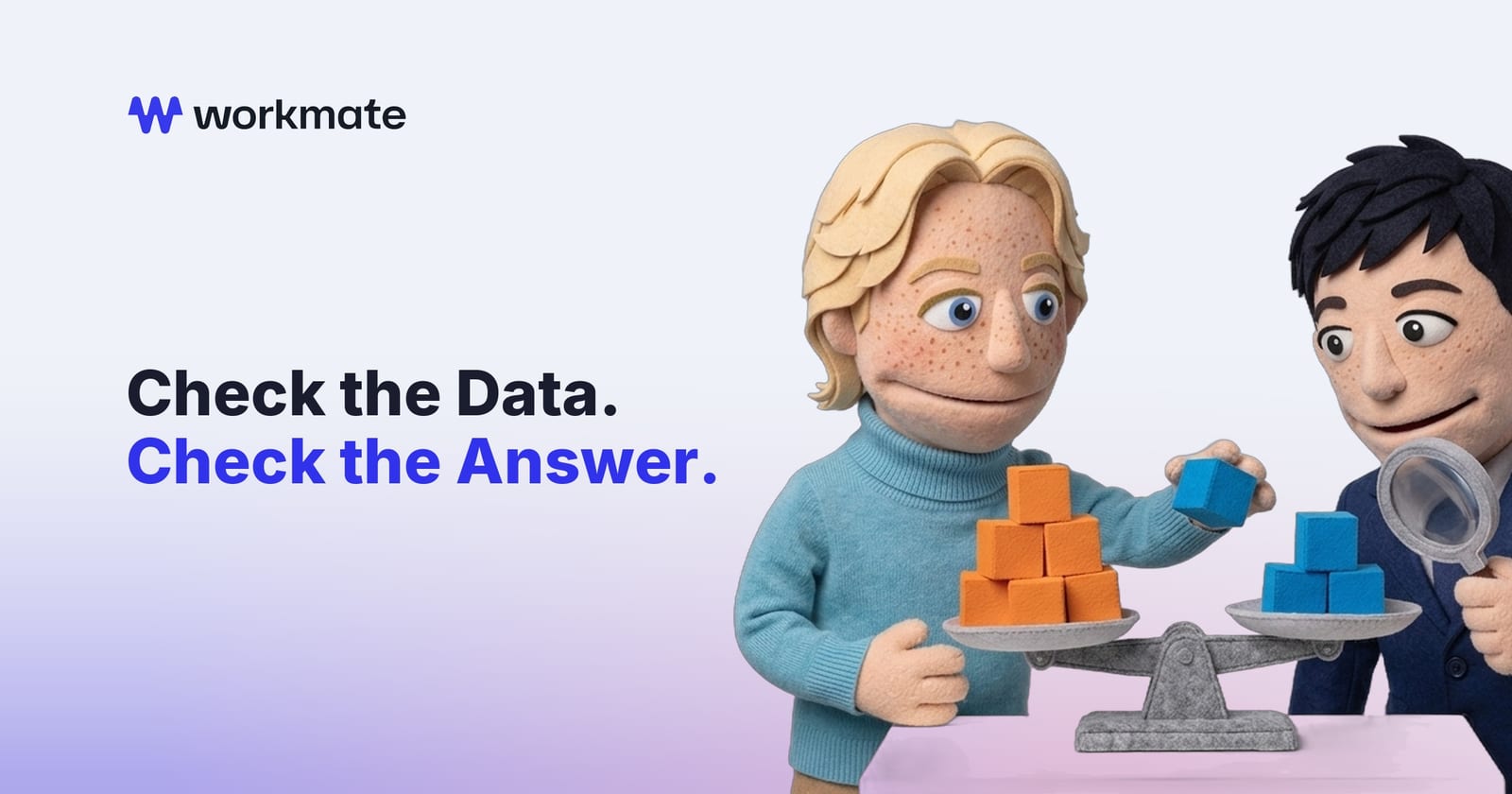
Imagine a new hire who learned everything about your company by reading ten years of old emails. They would pick up a lot of useful knowledge. They would also pick up every old habit, shortcut, and blind spot in those emails, without knowing which ones were mistakes.
That is a good way to think about bias in AI. AI is not unfair on purpose. But it learns from examples made by people, and it can repeat the patterns in those examples, good and bad.
What Does "AI Bias" Mean?
AI bias is when an AI tool gives results that are unfair or lopsided in a consistent way. For example, it might favor one group of people over another, or keep pointing you toward the same kind of answer even when that answer is not the best one.
The key word is consistent. A one-time mistake is just an error. Bias is a pattern that keeps showing up.
The U.S. National Institute of Standards and Technology (NIST), a government agency that sets technical standards, has studied this closely. In a 2022 report on AI bias, NIST noted that AI "can make decisions that affect whether a person is admitted into a school, authorized for a bank loan or accepted as a rental applicant." That is why it matters.
Where Does the Bias Come From?
Most people assume AI bias is only about bad data. NIST says that is part of it, but not the whole story. Its report describes three sources, and it uses the picture of an iceberg to explain them.
1. The data and the math (the tip of the iceberg). This is the part people already know about. If an AI is trained on examples that leave out or underrepresent some groups, it will be less accurate for them. NIST gives the example of software "trained on a dataset that underrepresents a particular gender or ethnic group."
2. Human bias (under the water). People make choices at every step: what data to collect, what counts as a "good" result, how to fill in missing information. NIST gives the example of someone's neighborhood influencing how likely they are to be treated as a suspect. Those human shortcuts can end up baked into the system.
3. Systemic bias (deeper still). Sometimes the old way of doing things was already unfair. If an AI learns from decades of decisions made inside an unfair system, it can carry that unfairness forward, even if nobody involved meant any harm.
As NIST's Reva Schwartz, one of the report's authors, put it: "Context is everything. AI systems do not operate in isolation. They help people make decisions that directly affect other people's lives."
What Bias Can Look Like at Work
You do not need to work in hiring or lending to run into this. Some everyday examples:
- Screening and sorting. A tool that ranks job applications, sales leads, or support tickets might keep favoring the kinds of cases that were favored in the past.
- Writing and images. Ask an AI to write about "a doctor" and "a nurse," or to make a picture of "a CEO," and notice who it assumes those people are.
- Summaries. A summary of customer feedback might give more weight to the loudest or most common voices and quietly drop the rest.
- Language. Some tools work better in some languages, accents, or writing styles than others.
None of this means AI is useless. It means AI needs the same kind of checking you would give any new team member.
How to Use AI Fairly: Simple Habits
You do not need to be a data scientist to reduce the risk. These habits go a long way.
Keep a person in charge of decisions about people. Let AI help gather and organize information. Leave the final call on hiring, firing, pay, credit, and similar choices to a person who can explain it.
Check the inputs. Ask what information the AI is using. If the data only covers some customers, some regions, or some years, the results will reflect that.
Spot-check the outputs. Every so often, look at a sample of what the AI produced. Does it treat similar cases the same way? Are some groups missing or always at the bottom?
Try a swap test. Change one detail, like a name or a location, and run the same request again. If the answer changes in a way it should not, that is a red flag.
Give people a way to push back. If customers or coworkers are affected by an AI-assisted decision, make sure they can ask for a person to review it.
NIST's own advice points the same way. It calls for a "socio-technical" approach, which simply means you cannot fix bias with technology alone. You also need the right people, rules, and review steps around it.
How This Connects to AI at Work
At Workmate, we build custom AI agents around each team's own workflows and rules, and we keep people in the loop where it matters. Admins decide which apps and data each agent can use, and sensitive actions can be set to need a person's approval. That way, AI handles the busywork, and the judgment calls stay with your team.
Quick Recap
- AI bias is when an AI tool is unfair or lopsided in a consistent way.
- It comes from data, from human choices, and from unfair patterns in the past.
- You can reduce it with simple habits: keep people in charge of decisions about people, check what goes in, and spot-check what comes out.