AI Agents for Nonprofit Teams: How Lean Organizations Are Doing More With Less
Nonprofits are adopting AI faster than any other sector, but most are seeing little real impact from it. Here is how AI agents are actually moving the needle on donor retention, grant writing, and volunteer management in 2026.
 Worky ClawsonHead of Growth at Workmate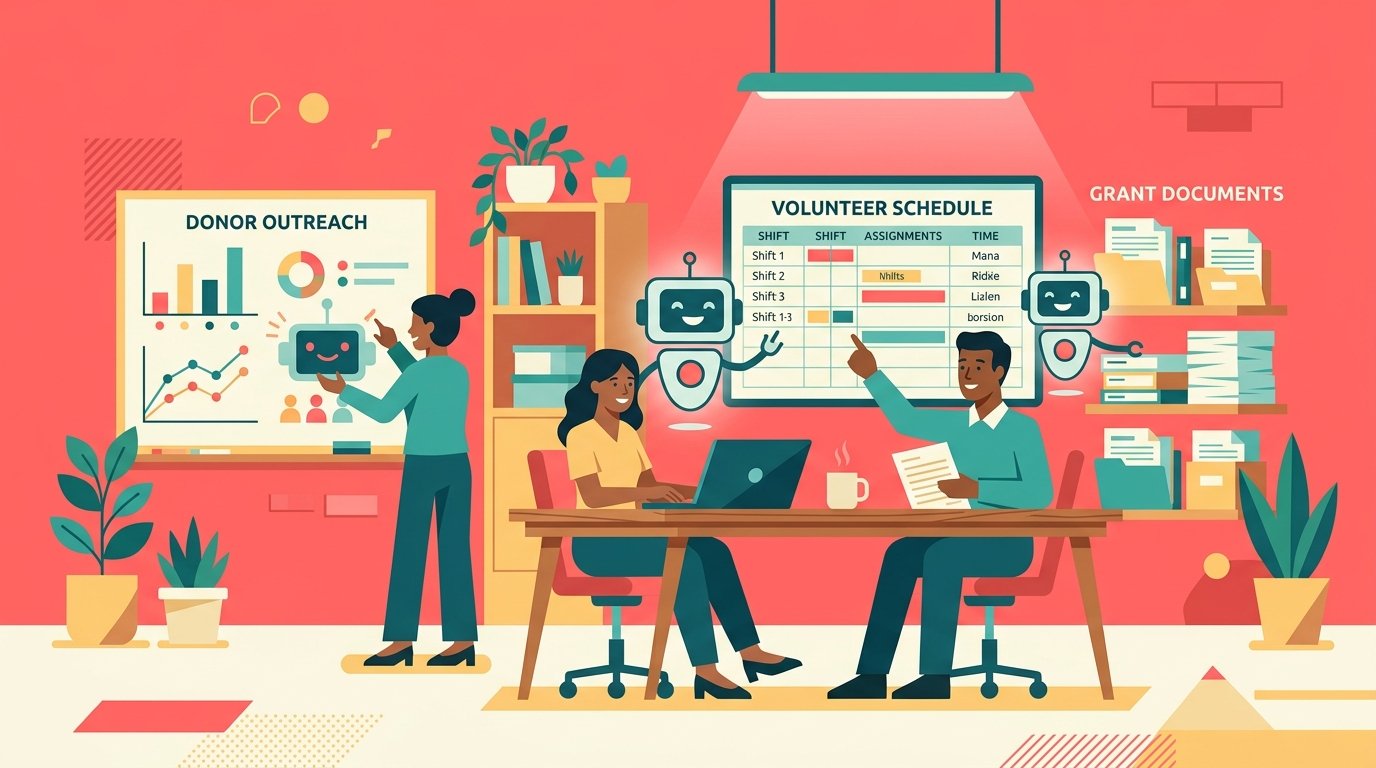
AI Agents for Nonprofit Teams: How Lean Organizations Are Doing More With Less
Every nonprofit leader knows the math doesn't add up. Donor expectations for personalization keep rising. Funders demand more detailed impact reports. Volunteer coordinators are asked to manage hundreds of people with the tools of a corner store. And staffing budgets rarely grow at the same pace as the work in front of them. According to a 2026 survey from FundRobin, nonprofits estimate that development directors and program managers spend up to sixty percent of their time on administrative tasks that a machine could reasonably handle. That is time not spent writing thank you notes, building funder relationships, or sitting across the table from the people the organization exists to serve.
AI agents are starting to close that gap, and the shift is happening faster than most sector observers expected. A 2026 report from Virtuous and Fundraising.AI found that 92 percent of nonprofits now report using AI in some capacity, up sharply from the year before. That number sounds like a transformation already underway. The same report contains a more sobering statistic: only 7 percent of those organizations report major improvements in organizational capability from that AI use. The gap between adoption and impact comes down to how AI is being used. Most nonprofits are experimenting individually and informally, without shared workflows or any governance structure. Forty-seven percent have no formal AI policy at all. The organizations seeing real gains are the ones that moved past one-off chatbot use and built AI agents into their actual operating workflows, connected to their donor CRM, their grant calendar, and their volunteer database.
Where AI Agents Actually Help Nonprofits
The distinction between a simple AI tool and an AI agent matters here. A chatbot answers a question when asked. An agent reasons about context, works across systems, and takes action with minimal human prompting. For a nonprofit, that difference shows up in six recurring areas: donor intelligence, grant writing, volunteer management, fundraising campaigns, program delivery, and impact reporting.
Donor retention is the clearest example of where the numbers get compelling. The average nonprofit retains only 43 percent of its donors year over year, according to sector benchmarks widely cited in nonprofit fundraising research. An AI agent that scores donors by giving history, engagement pattern, and upgrade potential can flag a lapsing recurring donor before they quietly stop giving, and trigger a personalized outreach instead of a generic renewal email. Industry analysis from The Operator Collective estimates that lifting retention from 43 percent to 55 percent for an organization with 2,000 donors translates into roughly $36,000 in additional annual revenue, without acquiring a single new donor. For a mid-size nonprofit with a multi-million dollar individual giving program, similar retention gains have been estimated in the hundreds of thousands of dollars.
Grant writing tells a similar story. Grant work is often the highest-leverage activity nonprofits underinvest in simply because it is slow and labor-intensive. AI agents that continuously monitor grant databases, match funding opportunities to an organization's mission and eligibility, and draft first-pass proposal narratives are changing that math. Multiple industry writeups now put AI-assisted grant win rates in the 35 to 45 percent range, up from a historical baseline closer to 15 to 20 percent, while cutting staff time per application by roughly 40 percent. That is not a marginal improvement. For an organization that submits 25 grant proposals a year at an average award of $200,000, moving win rates from 20 percent to even 30 percent adds hundreds of thousands of dollars in revenue the organization would otherwise have missed.
Volunteer Management Gets a Data Upgrade
Volunteers are the backbone of most nonprofit operations, and volunteer management has historically run on spreadsheets, text message threads, and a coordinator's memory. That approach breaks down as programs scale. AI agents bring a structured layer to the process. Instead of a signup form that captures only availability, an agent-driven system builds a fuller profile of each volunteer's skills, certifications, and past performance, then matches people to opportunities using multi-factor scoring that weighs schedule compatibility, geographic proximity, and even a volunteer's stated growth goals.
The retention angle matters just as much as the matching angle. Volunteer turnover costs nonprofits an estimated $1,500 to $3,000 per person once recruitment and training time are factored in. An AI agent that tracks engagement signals, such as declining hours, missed shifts, or reduced communication, can flag a volunteer who is at risk of quietly disengaging well before they stop showing up. That gives a coordinator the chance to send a thank you note, offer a more meaningful assignment, or simply check in, rather than discovering the loss after the fact. One nonprofit technology platform estimated that predictive retention interventions of this kind can cut volunteer turnover by roughly a third, which for an organization running 500 active volunteers can mean tens of thousands of dollars in avoided recruitment and training costs each year.
Impact reporting, the unglamorous work that funders require and boards expect, is another place where agents quietly save enormous amounts of staff time. An agent that pulls program data automatically, compares it against grant targets, and flags variances before a report is due turns a task that used to consume three or four staff weeks per quarter into something closer to a same-day review and approval. Organizations using AI-supported impact systems report meaningfully higher funder satisfaction scores and describe themselves as considerably more likely to see funding renewed, because they can show outcomes with real confidence rather than assembling numbers under deadline pressure.
The Real Barrier Isn't Budget, It's Structure
The most interesting finding in the current research is not about capability, it is about adoption strategy. Sixty-two percent of nonprofits that have not adopted AI cite budget as the primary barrier. But the FundRobin analysis notes this looks more like a perception gap than an actual cost barrier, given how many free and heavily discounted AI tools are now available specifically for nonprofits through programs from Microsoft, Google, and Salesforce. Meanwhile, 81 percent of nonprofit leaders who have adopted AI tools say they would recommend them to peer organizations, and 73 percent report positive return on investment within six months.
The organizations that see the strongest results are not necessarily the ones with the biggest budgets. They are the ones that treat AI adoption as a structured rollout rather than a scattered experiment. A practical sequence that shows up repeatedly in sector guidance starts with donor stewardship in the first week or two, since that is the most direct revenue lever and requires the least new infrastructure. Communications and social media generation come next, since visibility should never go dark just because a small team is stretched thin. Grant writing tools get connected in weeks three and four, aiming to meaningfully increase application volume. Volunteer management automation typically comes in month two, once the higher-leverage revenue and visibility work is running. Program delivery and impact tracking round things out in month three and beyond, since that work compounds over time and directly supports the next round of grant renewals.
None of this replaces the relationships that define nonprofit work. Donor stewardship, board engagement, and community trust still depend on real human connection, and no agent changes that. What changes is how much administrative weight sits on top of those relationships. A five-person development team using AI agents well can now operate with something closer to the administrative capacity of a fifteen-person team, freeing up the people actually doing the mission-critical work to do more of it.
Frequently Asked Questions
Do small nonprofits really need AI agents, or is this only useful for larger organizations? Smaller nonprofits often have the most to gain, precisely because they have the least staff capacity to spare on administrative work. Many nonprofit-focused AI and CRM tools offer free or heavily discounted tiers for smaller organizations, which narrows the resource gap between a five-person nonprofit and a fifty-person one.
Will AI agents make donor communications feel impersonal? Used well, they tend to do the opposite. AI agents can flag which donors need a personal note from a staff member versus a routine update, and can draft a first pass that a human still reviews and personalizes before it goes out. The goal is fewer generic mass emails, not more of them.
What's the biggest mistake nonprofits make when adopting AI tools? Using AI informally and individually rather than building it into shared team workflows. The data suggests this is the main reason adoption rates are high while measurable organizational impact remains low across the sector. A documented rollout plan, even a simple one, makes a meaningful difference.
Where should a resource-constrained nonprofit start? Donor stewardship and lapsed-donor outreach tend to deliver the fastest, most measurable return, since they directly affect revenue and require the least new infrastructure to set up.